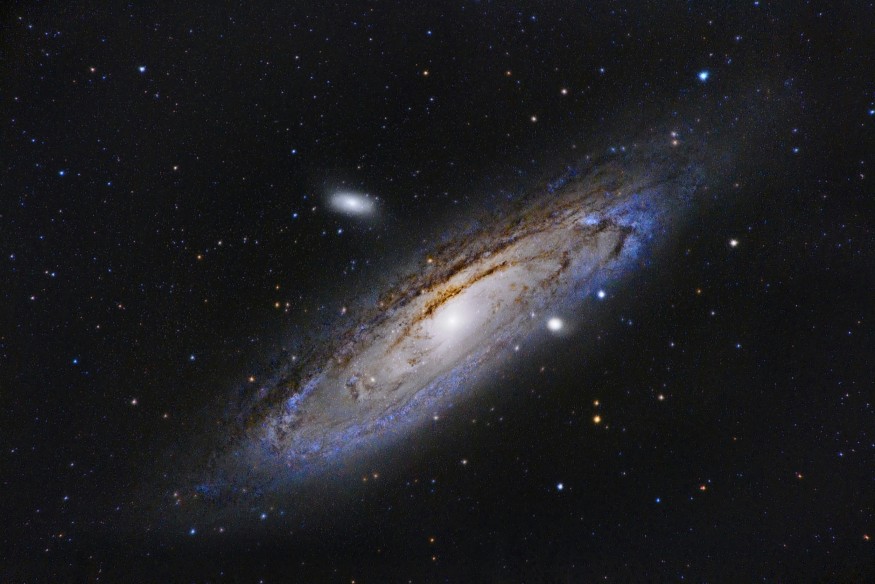
The universe's origin is one of science's most profound questions, and Big Bang science offers the most complete explanation so far. It proposes that everything began 13.8 billion years ago from an extremely hot, dense state where space and time themselves emerged. Rather than an explosion in space, the Big Bang describes the rapid expansion of space itself.
Evidence supporting this view has grown stronger over decades. Observations of galaxy motion, ancient radiation, and elemental composition all point back to a shared beginning. Yet modern discoveries, especially from the James Webb Space Telescope, are revealing surprises that challenge assumptions about how quickly structure formed. These findings are refining, not replacing, our understanding of cosmic beginnings.
Big Bang Science Evidence Supporting the Universe Origin
Big Bang science rests on multiple independent observations that converge on a single universe origin model. One of the strongest confirmations comes from the observed expansion of the universe. Galaxies move away from each other at speeds proportional to their distance, measured at roughly 70 kilometers per second per megaparsec. This expansion implies that the universe was once far smaller and denser.
Elemental composition provides further support. The universe consists of about 75 percent hydrogen and 25 percent helium, with trace lithium. These ratios match precise predictions from nuclear reactions occurring within the first three minutes after the Big Bang. No other known process explains this balance so accurately.
The cosmic microwave background strengthens the case. This faint radiation fills space uniformly at 2.7 Kelvin, with tiny fluctuations at a level of one part in 100,000. Those fluctuations became the gravitational seeds that later grew into galaxies and clusters, linking early conditions directly to today's cosmic structure.
Universe Origin Questions and Challenges Within Big Bang Science
The Big Bang theory has long been the cornerstone of cosmology, explaining the universe's expansion and formation. Despite its success, some observations challenge its completeness. Scientists continue to probe gaps in our understanding, from cosmic expansion rates to the uniformity of distant regions. These puzzles highlight the complexity of unraveling the universe's earliest moments.
- Inflation theory: Proposed to explain why the universe appears geometrically flat and uniform across vast distances. It suggests a brief burst of exponential expansion lasting less than a trillionth of a second, accounting for similar properties in regions that were never in contact.
- Hubble tension: A major challenge where cosmic microwave background measurements predict an expansion rate of about 67 km/s per megaparsec, while supernova observations suggest around 73 km/s per megaparsec. This discrepancy may indicate unknown physics or hidden cosmic structures.
- Local void hypothesis: Suggests Earth lies within a massive underdense region of space, making nearby expansion appear faster than the global average. This could partially resolve the Hubble tension without overturning Big Bang science.
New Ideas on Universe Origin Beyond Traditional Big Bang Science
Observations from cutting-edge telescopes are challenging conventional timelines of the early universe. Massive, well-formed galaxies appear to exist far sooner than predicted by traditional Big Bang models. This has prompted scientists to revisit and expand theories about the universe's origin. Alternative models may provide explanations for phenomena that standard theory struggles to address.
- Early galaxy formation: James Webb Space Telescope observations reveal massive galaxies just 300 million years after the Big Bang, raising questions about star formation speed and early universe physics.
- Cyclic universe theories: Propose that the universe undergoes endless cycles of expansion and contraction, eliminating the need for a singular beginning. Each expansion follows a previous collapse.
- Quantum gravity models: Loop quantum gravity suggests a "Big Bounce" instead of a singularity, where extreme density causes a rebound rather than a breakdown of physical laws. This preserves causality while remaining compatible with evidence of cosmic expansion.
Big Bang Science Observations That Anchor the Universe Origin
Large-scale cosmic patterns provide additional support for Big Bang science. Baryon acoustic oscillations appear as faint rings in galaxy distributions roughly 490 million light-years across. These patterns match sound waves frozen into matter shortly after the Big Bang, mirroring structures seen in the cosmic microwave background.
Dark energy plays a critical role in modern cosmology. It accounts for about 68 percent of the universe's total energy content and drives accelerated expansion. Observations of distant Type Ia supernovae appear dimmer than expected, indicating space is expanding faster over time.
Together, these observations anchor the universe origin model. While details continue to evolve, the large-scale consistency between early-universe signals and present-day structure remains a major strength of Big Bang science.
Conclusion
The universe origin described by Big Bang science remains the most comprehensive framework for explaining cosmic history. Evidence from galaxy motion, background radiation, and elemental composition continues to support a shared beginning. Even challenges like inflation uncertainties and the Hubble tension point toward refinement rather than failure of the model.
New data, particularly from the James Webb Space Telescope, is reshaping assumptions about early structure formation. These discoveries may adjust timelines and mechanisms without discarding the core idea of cosmic expansion. As theory and observation advance together, Big Bang science remains flexible, resilient, and central to understanding how the universe began.
Frequently Asked Questions
1. What evidence supports Big Bang science?
The strongest evidence includes galaxy redshifts, cosmic microwave background radiation, and elemental abundances. Each points to a hot, dense early universe. These observations are independent yet consistent. Together they strongly support a shared cosmic origin.
2. Was the universe's origin a true singularity?
A mathematical singularity appears in classical equations. Many physicists believe quantum gravity removes this infinite point. Models like the Big Bounce replace it with a high-density state. The exact nature remains unknown.
3. What causes the Hubble tension?
Different measurement methods produce conflicting expansion rates. Local supernova observations give higher values than early-universe measurements. This may indicate local cosmic structure effects. It could also suggest new physics.
4. Does JWST disprove Big Bang science?
No, it challenges aspects of early galaxy formation timelines. The core expansion model remains intact. JWST reveals complexity, not contradiction. Its data may strengthen the theory through refinement.
© 2026 ScienceTimes.com All rights reserved. Do not reproduce without permission. The window to the world of Science Times.


