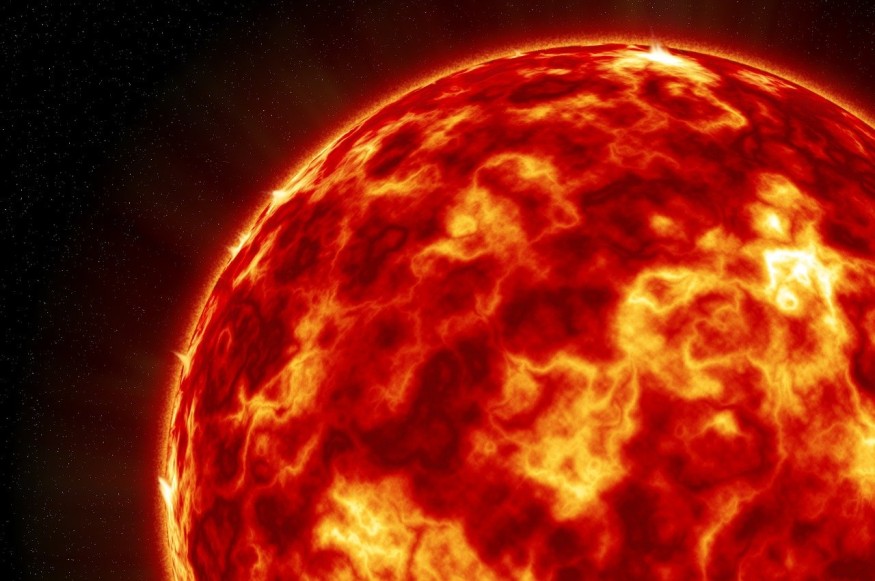
The Sun does not produce sound in space the way a speaker does in air, because sound waves need a medium like air or water to travel. In the vacuum of space, there is not enough matter to carry ordinary Sun sounds to human ears.
Inside the Sun, however, hot plasma constantly moves, compresses, and vibrates, creating pressure waves and oscillations that behave much like sound waves within the star itself.
These internal motions generate what are often called "Sun sounds" once scientists translate the data into audio. In reality, these recordings are not raw sound picked up by a microphone in space, but processed representations of solar activity.
They are built from measurements of motion, energy, and solar waves in and around the Sun, then shifted into a frequency range that humans can hear, giving the star a kind of scientific "voice."
What NASA heard from the Sun
When NASA and its partners "listened" to the Sun, they started with precise observations from space-based instruments rather than conventional audio. Telescopes and spacecraft measure tiny movements on the Sun's surface, changes in brightness, and variations in magnetic and plasma behavior. These measurements capture patterns of solar waves and space vibrations that ripple through and around the star.
Once converted into sound, these patterns often resemble a low, continuous hum or rumble layered with faint fluctuations. To the human ear, Sun sounds can feel eerie or otherworldly, which explains why many descriptions highlight how haunting they seem. Behind this emotional reaction lies purely physical data that helps scientists better understand a dynamic and constantly changing star.
How NASA turns data into "Sun sounds"
Listening to the Sun begins with detecting motion. Specialized instruments record tiny Doppler shifts, changes in the apparent wavelength of light, as material on the Sun's surface moves toward or away from the observer.
These shifts reveal the presence of solar waves and oscillations traveling through the Sun's outer layers, while other instruments track fluctuations in plasma and magnetic fields that produce additional space vibrations.
Scientists then use a process called sonification to convert these measurements into audio. They map changes in frequency, intensity, or position onto sound parameters such as pitch and volume.
Because many solar waves oscillate far too slowly or too quickly to be heard directly, the data are often sped up or shifted into the human auditory range. The result is an audio stream that condenses complex solar behavior into audible Sun sounds.
Does the Sun actually make sound?
Inside the Sun, conditions are very different from the vacuum of space. The solar interior is filled with dense, hot plasma, where pressure waves can propagate much like sound does through air.
These waves are sometimes described as the Sun "ringing" or "singing," because the entire star can vibrate in many modes at once, much as a struck bell vibrates in characteristic patterns.
This phenomenon forms the foundation of helioseismology, the study of the Sun's internal structure through its oscillations. By analyzing these internal "Sun sounds," scientists can infer what is happening deep below the visible surface.
The waves reveal how temperature, density, and motion change with depth, providing a kind of ultrasound of the Sun's interior and turning solar waves into diagnostic tools.
What the Sun sounds like to human ears
When transformed into audible audio, Sun sounds typically resemble a deep, steady hum or roar. The tone is often low and continuous, reflecting broad, long-lasting solar waves that span large regions of the star. Superimposed on this background may be subtle fluctuations, pulses, or higher-pitched elements tied to specific solar events or localized motions.
Many listeners describe these recordings as eerie because they lack the familiar structure of music or everyday noise. There is no clear melody or rhythm, only relentless vibration. In some cases, when data from solar wind or other space vibrations are included, the soundscape can contain whines, chirps, or crackling textures, reflecting changes in charged particles and electromagnetic fields as they move through space around the Sun.
How loud would the Sun be?
Considering how loud the Sun might be helps explain the role of space as a near-vacuum. If a person could somehow stand near the Sun's surface in a medium that carries sound, the intense pressure waves and turbulent motion would likely create an environment so loud as to be unimaginable. The constant convective boiling on the solar surface would produce powerful, continuous noise.
On Earth, none of that direct sound reaches the planet because there is no continuous material bridge of air between the Sun and our atmosphere. Instead, electromagnetic radiation and streams of particles such as the solar wind travel through space.
This is why recordings of Sun sounds must start from visual, magnetic, or particle data and then be converted, rather than from sound waves traveling directly through space.
The science behind solar waves and space vibrations
Solar waves come in several forms, including pressure waves, gravity waves, and magnetohydrodynamic waves that involve both plasma and magnetic fields. Convection beneath the Sun's surface continually stirs the plasma, while magnetic fields twist and reconnect. These processes generate waves that travel upward, downward, and across the Sun in intricate patterns.
The entire star behaves like a resonant object, vibrating in many modes at once. Each oscillation mode has a specific frequency and spatial pattern, and together they form the Sun's acoustic spectrum.
By analyzing this spectrum, scientists can map flows beneath the solar surface, detect subtle changes in rotation, and study the behavior of solar cycles, turning solar waves and space vibrations into powerful diagnostic tools.
What Sun sounds reveal about our star
Sonified Sun sounds offer more than curiosity value. They allow researchers to identify periodicities and trends in solar activity that might be less obvious in raw numerical form.
Shifts in the frequencies of certain solar waves can signal changes in the Sun's magnetic field or internal flows, connecting directly to the rise and fall of solar cycles, Sunspots, and eruptive events.
Improved understanding of these patterns helps refine models of space weather, the stream of solar activity that can affect satellites, power grids, and communication systems on Earth.
By studying how solar waves behave before, during, and after solar flares or coronal mass ejections, scientists can strengthen forecasting and better anticipate potentially disruptive events driven by space vibrations.
Frequently Asked Questions
1. Can Sun sounds help detect solar storms earlier?
Sun sounds can indirectly help researchers spot patterns in solar activity that precede storms. By tracking subtle changes in the frequencies or intensities of solar waves, scientists may identify signatures of energy buildup before a flare or coronal mass ejection.
2. Do other stars have "sounds" similar to the Sun?
Other stars are also made of hot plasma and experience internal oscillations, so they have starquakes and wave patterns that can be studied similarly. Astronomers use asteroseismology, essentially helioseismology applied to other stars, to infer their internal structures, and, in principle, these oscillations could also be translated into audio-like "star sounds."
3. How are Sun Sounds useful for visually impaired people?
Sun sounds and other sonified space data give visually impaired people direct access to complex scientific information without relying on charts or images. Changes in pitch, rhythm, or texture can represent different physical properties, allowing listeners to perceive patterns, trends, or anomalies that sighted researchers might see in graphs.
4. Can AI be used to analyze Sun sounds and space vibrations?
AI and machine learning can scan large sets of sonified data and underlying numerical records to find patterns that are difficult for humans to spot. By training models on known events such as solar flares, AI could help flag unusual combinations of solar waves and space vibrations that might signal emerging activity or new physical processes.
© 2026 ScienceTimes.com All rights reserved. Do not reproduce without permission. The window to the world of Science Times.


