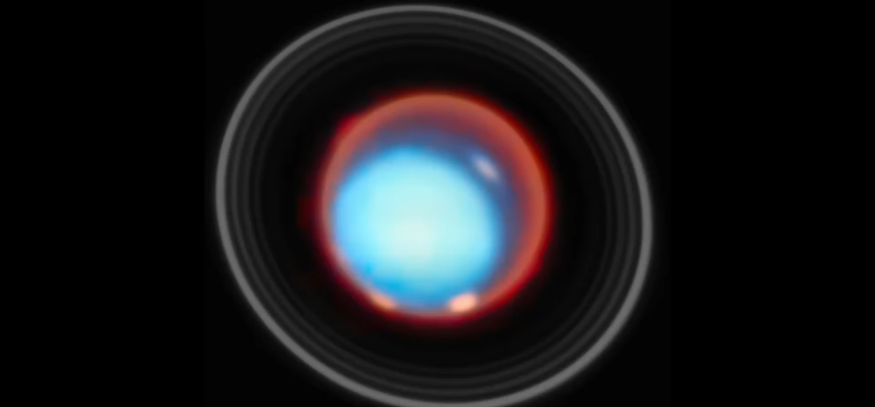
The distant ice giant Uranus has long puzzled astronomers with its sideways tilt and unusual magnetic behavior. Now, the James Webb Space Telescope has delivered the first-ever three-dimensional map of the planet's upper atmosphere, offering an unprecedented look at how energy and charged particles move above its clouds.
This JWST Uranus discovery reveals glowing auroral bands, dark emission regions, and dramatic temperature shifts shaped by a warped magnetic field. By tracking ionized gases thousands of kilometers above the surface, scientists are uncovering how magnetic activity on Uranus influences its atmospheric balance and long-term cooling.
James Webb Space Telescope Uranus Mapping
The James Webb Space Telescope used its Near-Infrared Spectrograph (NIRSpec) Integral Field Unit to observe Uranus continuously for nearly 15 hours—almost one full planetary rotation. These measurements captured faint molecular emissions, including H3+ and methane, allowing researchers to map temperature and ion densities up to 5,000 kilometers above the visible cloud tops.
This JWST Uranus discovery revealed that ion densities peak around 1,000 kilometers in the ionosphere, while temperatures reach their highest levels between 3,000 and 4,000 kilometers. Bright auroral bands appear near the magnetic poles, alongside darker regions where emissions and ion concentrations drop. These patterns reflect how magnetic activity on Uranus channels charged particles along distorted field lines, shaping the planet's vertical atmospheric structure and energy flow.
Read more: James Webb Space Telescope Distant 'Cosmic Jellyfish' Galaxy with Star-Forming Gas Tentacles
Uranus Aurora Magnetic Field
The newly detailed Uranus aurora appears as two luminous bands near the magnetic poles. Unlike most planets, the Uranus magnetic field is tilted about 59 degrees from its rotation axis and offset from the planet's center. This unusual geometry creates sweeping auroras that move across the planet in complex patterns as Uranus rotates.
Webb's observations show how this lopsided magnetosphere guides charged particles into the upper atmosphere, triggering infrared emissions. Between the two bright auroral bands, scientists identified a region with reduced ion density and weaker emissions, likely linked to transitions in magnetic field lines. Earlier data from Voyager 2 and the Hubble Space Telescope hinted at these effects, but the new 3D mapping reveals how deeply the magnetic field influences atmospheric layers.
Uranus Magnetic Field Cooling Trends
The Uranus magnetic field also plays a role in newly confirmed cooling trends. Measurements show an average upper atmospheric temperature of about 426 kelvins (around 150°C), lower than values recorded by ground-based observatories and earlier spacecraft missions. This supports evidence that Uranus has been cooling since the 1990s.
Magnetic activity on Uranus affects how energy moves upward through the ionosphere, influencing the planet's overall heat balance. The complex geometry of its dynamo-generated magnetic field—possibly shaped by internal convection currents or past impacts—creates noticeable longitude variations in emissions and temperature. By mapping these patterns, Webb provides key insights not only into Uranus but also into other ice giants like Neptune and distant exoplanets with similar characteristics.
What JWST Uranus Discovery Means for Ice Giants
This JWST Uranus discovery marks a major step in understanding how ice giants manage energy in their upper atmospheres. The detailed 3D view shows how auroras, ion densities, and temperature layers are intertwined with one of the strangest magnetic fields in the solar system.
As the James Webb Space Telescope continues to refine its observations, scientists are gaining a clearer picture of magnetic activity on Uranus and how it shapes atmospheric behavior. These insights extend beyond our solar system, helping researchers interpret similar signals from giant exoplanets orbiting distant stars.
© 2026 ScienceTimes.com All rights reserved. Do not reproduce without permission. The window to the world of Science Times.


