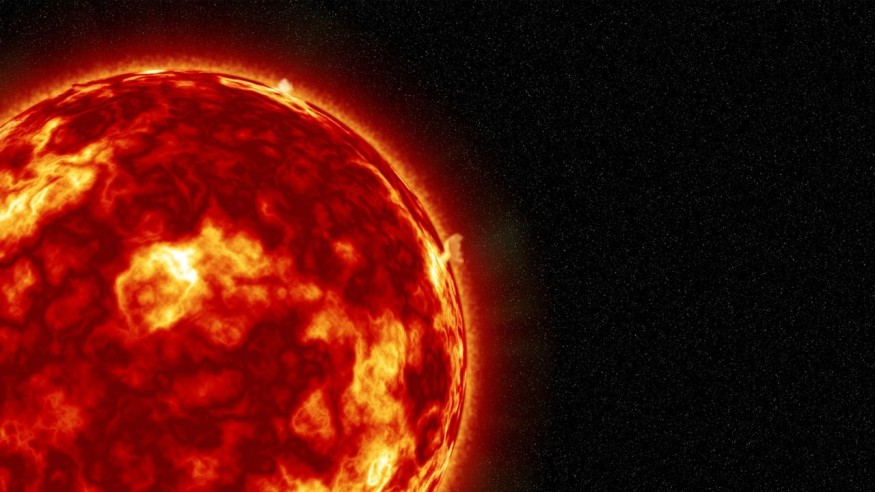
A solar flare is among the most powerful and dynamic phenomena occurring on the Sun, representing intense bursts of electromagnetic radiation caused by complex magnetic activity. These solar eruptions can dramatically influence space weather, affecting communication systems and technologies on Earth.
Understanding what happens during a solar flare, including its causes, phases, and effects, is essential for grasping how our closest star behaves and affects our planet.
Introduction to Solar Flares
A solar flare is an explosion of energy from the Sun's atmosphere, particularly in regions with strong magnetic fields such as sunspots. These regions store magnetic energy due to the twisting and tangling of invisible magnetic fields. When this energy is rapidly released, it produces a flare, a burst of radiation that spans the entire electromagnetic spectrum, from radio waves up to gamma rays.
Solar flares result from magnetic reconnection, a process where magnetic field lines break and reconnect, converting magnetic energy into thermal and kinetic energy. This rapid energy release heats the solar plasma to tens of millions of degrees Kelvin and accelerates charged particles near the speed of light.
Often, solar flares are accompanied by coronal mass ejections (CMEs), massive bursts of solar material that propel billions of tons of plasma into space and influence space weather.
What Causes a Solar Flare?
Solar flares form in active regions of the Sun where magnetic fields are most intense, such as around sunspots. These fields are distorted over time by plasma flow and convection beneath the solar surface, creating a tangled, sheared magnetic structure in the corona. The buildup of energy in these magnetic fields eventually leads to a sudden release through magnetic reconnection.
Magnetic reconnection occurs when oppositely directed magnetic fields break and reconnect into a lower-energy configuration, releasing the excess energy stored in the magnetic field. This process powers the acceleration of charged particles and the emission of electromagnetic waves. The solar flare's onset is often triggered by small-scale magnetic flux disturbances near polarity inversion lines on the Sun's surface, which then escalate into full solar eruptions.
This eruptive activity involves three key phases: the precursor phase (energy buildup), the impulsive phase (rapid particle acceleration and peak radiation), and the gradual phase (plasma cooling and magnetic restructuring).
The combined effects of this process produce not only solar flares but also, in many cases, coronal mass ejections, massive expulsions of solar plasma that travel into space at speeds of up to thousands of kilometers per second.
What Happens During a Solar Flare?
During a solar flare, the Sun's magnetic fields restructure explosively. The initial energy stored in tangled magnetic loops is quickly liberated through magnetic reconnection, propelling electrons and protons to high velocities. This accelerated plasma emits intense radiation from radio frequencies to X-rays and even gamma rays.
The flare's electromagnetic output heats the solar atmosphere's plasma rapidly, raising its temperature above 10 million Kelvin. This heating results in brightening at ultraviolet and X-ray wavelengths, detectable by space-based telescopes and instruments.
The event begins with a slow buildup of energy, followed by a sudden, intense peak in radiation and charged-particle emission. It ends with a gradual cooling period as the magnetic field stabilizes.
Additionally, solar flares are often linked with coronal mass ejections, huge bubbles of magnetized plasma launched from the Sun's corona. These CMEs carry billions of tons of solar material outward, potentially impacting Earth's magnetosphere and contributing to geomagnetic storms. The combination of solar flares and CMEs plays a crucial role in driving space weather events.
Read more: How Old Is the Sun and When Will It Die? Understanding Its Life Cycle and Stellar Evolution
Solar Flare Effects and Space Weather
Solar flares influence space weather by emitting vast quantities of electromagnetic radiation and highly accelerated particles. When these emissions reach Earth, they can disrupt radio communications, navigation systems, and satellite operations, especially on the sunlit side of the planet where the ionosphere interacts directly with solar particles.
The X-rays and extreme ultraviolet radiation from a flare ionize the upper atmosphere, occasionally causing radio blackouts and communication degradation. Meanwhile, the energetic particles and the associated coronal mass ejections can trigger geomagnetic storms, affecting power grids and causing auroras near polar regions.
Monitoring solar flares and their accompanying CMEs is vital for predicting space weather and mitigating risks to modern technological infrastructure. Space agencies and research organizations worldwide track these events continuously to provide timely alerts and safeguard satellites, astronauts, and ground-based systems.
In summary, a solar flare is a powerful sun eruption caused by magnetic reconnection in the Sun's atmosphere that releases immense energy as radiation and high-speed particles. Often linked with coronal mass ejections, these flares affect space weather by disrupting Earth's atmosphere and technological systems.
Understanding their formation, progression, and effects helps scientists anticipate space weather impacts and better prepare for these solar events.
Frequently Asked Questions
1. How are solar flares classified by strength?
Solar flares are categorized into classes A, B, C, D, and X based on their peak X-ray flux measured by satellites, with each class increasing in intensity by a factor of 10; for example, an X1 flare is 10 times stronger than an M1 flare. X-class flares, the most powerful, can cause widespread radio blackouts and are often linked to significant coronal mass ejections.
2. Can solar flares damage satellites directly?
Solar flares primarily affect satellites through increased atmospheric drag from ionospheric expansion and radiation-induced glitches in electronics, though the high-energy particles from associated coronal mass ejections pose greater risks to satellite components. Spacecraft operators mitigate this by powering down non-essential systems during predicted events.
3. How do scientists predict solar flares?
Predictions rely on monitoring sunspot magnetic complexity, active-region evolution via telescopes operated by NASA and NOAA, and machine-learning models analyzing historical data to estimate eruption likelihood. While short-term forecasts (hours to days) have improved, exact timing remains challenging due to chaotic magnetic processes.
4. Do solar flares influence Earth's long-term climate?
Solar flares cause short-term atmospheric changes, such as ionospheric heating, but do not drive long-term climate shifts, which are dominated by factors such as greenhouse gases; broader solar cycles have a minor influence on temperature variations. Recent studies note temporary regional weather anomalies from flares, though not sustained global effects.
© 2026 ScienceTimes.com All rights reserved. Do not reproduce without permission. The window to the world of Science Times.


