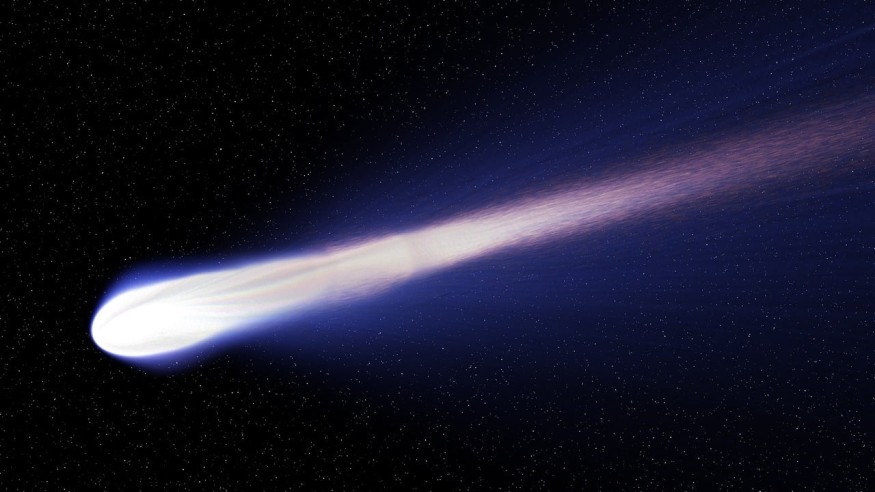
Scientists are assessing a new fast‑track mission concept that would use a daring solar "slingshot" maneuver to send a spacecraft after the fast‑receding interstellar comet 3I/ATLAS, but only if space agencies commit to a launch around 2035.
Why 3I/ATLAS Matters
Researchers from the UK‑based Initiative for Interstellar Studies (i4is) have outlined a mission that would not launch immediately but instead wait for a favorable alignment in the mid‑2030s, then dive close to the sun to gain a huge speed boost.
Their study shows that a launch in 2035 offers the most efficient path to the comet using a "Solar Oberth maneuver," in which a probe fires its engines at extremely high speed near the sun to maximize the thrust effect, according to Live Science.
The target, 3I/ATLAS, is only the third confirmed interstellar object known to have passed through our solar system, after 'Oumuamua and comet 2I/Borisov, making it a rare chance to study material from another star system.
It was discovered in 2025 by the ATLAS sky‑survey system in Chile, and its strongly hyperbolic orbit and high excess speed of about 60 kilometers per second showed it came from beyond the sun's gravitational control.
Because 3I/ATLAS was found late, when it was already inside Jupiter's orbit, the best window for a simple direct chase from Earth had already passed. A rendezvous mission that could slow down and travel alongside the comet is essentially ruled out by its speed and geometry, so experts now see a high‑speed flyby as the realistic option.
How the Solar 'Slingshot' Would Work
The new i4is plan would send a spacecraft from Earth to Jupiter first, using the giant planet's gravity to bend the trajectory inward toward the sun, Arxiv reported.
The probe would then plunge to about 3.2 solar radii from the sun's center, protected by a heat shield, and perform a powerful burn at this closest point to achieve a dramatic "slingshot" toward 3I/ATLAS in deep space.
Under this architecture, the spacecraft could intercept the comet 35 to 50 years after launch, potentially in the 2080s, at a distance of hundreds of astronomical units from the sun, far beyond the current reach of any human‑made probe.
One analysis estimates an encounter around 732 astronomical units, more than four times farther than Voyager 1's present distance of about 170 AU.
The study assumes use of powerful, near‑future hardware such as a fully refueled Starship Block 3 upper stage in Earth orbit to push the probe onto its complex path. Even so, the authors stress that approaching so close to the sun and operating a mission over several decades would pose major engineering and funding challenges.
Interest in 3I/ATLAS builds on earlier mission designs for generic interstellar comets, including a Southwest Research Institute concept that showed fast flybys of such objects are feasible with technology similar to current planetary missions.
With 3I/ATLAS now rapidly leaving the solar system, the new solar‑slingshot proposal is being framed as one of the last realistic chances to directly investigate this particular visitor from another star, as per Universe Today.
© 2026 ScienceTimes.com All rights reserved. Do not reproduce without permission. The window to the world of Science Times.


