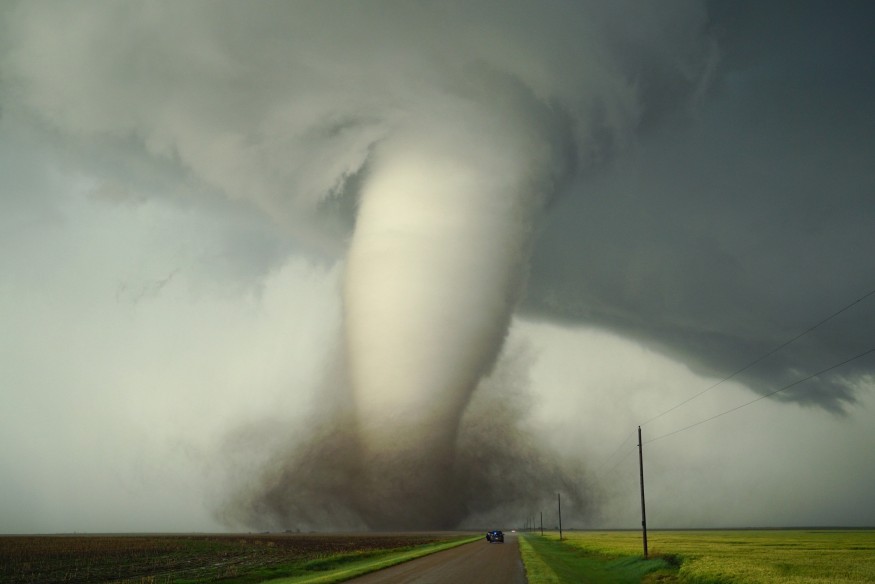
Tornadoes represent one of nature's most violent expressions of atmospheric energy, capable of reshaping landscapes within seconds. When examining the strongest tornadoes in history, scientists focus not only on visible destruction but also on radar data, pressure changes, and wind dynamics that define extreme tornado events. These storms push the physical limits of Earth's atmosphere, producing winds faster than race cars and pressure drops strong enough to pulverize pavement.
Understanding tornado records matters beyond curiosity. Scientific analysis helps explain why certain storms grow to unprecedented strength while others dissipate quickly. By examining historic extremes, meteorologists refine forecasting models, improve warning systems, and reduce loss of life in future tornado outbreaks.
Scientific Factors That Make the Strongest Tornadoes Possible
The strongest tornadoes form when rare atmospheric conditions align at extreme levels, almost always within long-lived supercell thunderstorms. These storms feature powerful mesocyclones driven by very high instability, often with CAPE values exceeding 6,000 J/kg, combined with strong vertical wind shear above 50 knots. This environment allows rotating updrafts to intensify instead of collapsing, creating the foundation for extreme tornado events capable of producing violent, long-track damage.
What separates the most extreme tornadoes is how efficiently storm-scale rotation tightens near the ground. Strong low-level wind shear and an intense rear-flank downdraft concentrate rotation at the surface, rapidly accelerating wind speeds, while dry air intrusion sharpens pressure gradients and moisture-rich inflow sustains explosive updrafts. Subvortices within the main funnel can locally exceed 175 mph, dramatically amplifying damage. Tornado strength is evaluated using the Enhanced Fujita (EF) Scale, supported by Doppler radar data, with the most violent tornadoes showing pressure drops over 150 millibars—enough to debark trees, scour pavement, and destroy well-built structures.
What Are the Strongest Tornadoes Ever Recorded?
Determining the strongest tornadoes in history requires combining wind speed estimates, damage severity, and documented impacts. This list is recency-biased, as modern Doppler radar, satellite data, and forensic damage surveys allow far better measurement than was possible decades ago. Older tornadoes may have been equally—or even more—powerful, but limitations in technology affect how confidently they can be ranked today.
1. Bridge Creek–Moore, Oklahoma (1999) – F5
This tornado is widely regarded as the strongest ever measured, with Doppler on Wheels recording winds of 321 mph, the highest reliably measured tornado wind speed in history. It carved a path up to 1 mile wide, obliterated entire neighborhoods, and killed 36 people. Damage was so extreme that homes were swept clean to bare slabs, and the total cost exceeded $1 billion, setting a benchmark for tornado intensity.
2. Tri-State Tornado (1925) – F5
Many experts argue this could realistically be #1 due to its unparalleled destruction. The tornado killed 695 people, injured over 2,000, and traveled an astonishing 219 miles across Missouri, Illinois, and Indiana—the longest continuous tornado path ever recorded. However, it ranks second due to major uncertainties: limited documentation, lack of wind measurements, and evidence suggesting it may have been a family of tornadoes rather than a single continuous vortex.
3. Jarrell, Texas (1997) – F5 ("Dead Man Walking")
Often cited as the most violent tornado in terms of damage, Jarrell's slow movement—sometimes nearly stationary—allowed destruction to compound. Wind speeds were estimated well above 260 mph, with homes pulverized into granules and asphalt scoured from roads. Though it killed 27 people, the extreme damage was amplified by its crawling forward speed of just 10–15 mph, making it uniquely devastating.
4. Smithville, Mississippi (2011) – EF5
This tornado intensified from EF0 to EF5 in roughly 6 seconds, an almost unheard-of escalation. Winds exceeded 200 mph, and the tornado carved trenches up to 1 foot deep into the ground, stripping pavement and debarking trees. While fatalities were lower (23 deaths), it is considered one of the best-documented violent tornadoes in history due to modern damage surveys and radar analysis.
5. El Reno–Piedmont, Oklahoma (2011) – EF5
This tornado earned its place through sheer force rather than death toll. Winds exceeded 210 mph, and it famously toppled and rolled a 2-million-pound oil derrick, one of the heaviest objects ever moved by a tornado. Though fatalities were limited (9 deaths), the degree of structural damage places it among the strongest EF5s ever recorded.
6. Phil Campbell–Hackleburg, Alabama (2011) – EF5
One of the longest-tracked violent tornadoes of the modern era, this EF5 traveled over 130 miles, killing 72 people. Entire towns were erased, and winds well over 200 mph destroyed reinforced buildings. The combination of long duration, width, and populated areas made it one of the deadliest tornadoes of the 21st century.
7. Joplin, Missouri (2011) – EF5
While not the strongest by wind speed alone, Joplin is the costliest tornado in history, causing $2.8 billion in damage. Winds exceeded 200 mph, and the tornado killed 158 people, largely due to a direct strike on dense urban areas. Its devastation reshaped emergency response, building codes, and warning systems nationwide.
8. Moore, Oklahoma (2013) – EF5
Striking the same region hit in 1999, this tornado produced winds near 210 mph, was 1.3 miles wide, and killed 24 people. Entire neighborhoods were leveled, and the cost reached $2 billion. Its intensity reaffirmed Moore as one of the most tornado-prone locations on Earth.
9. Xenia, Ohio (1974) – F5
Initially dubbed an "F6" by some researchers due to extreme damage, the Xenia tornado killed 33 people and devastated much of the city. Winds were estimated well over 260 mph, and entire commercial districts were destroyed. Its impact played a major role in the expansion of tornado warning systems in the U.S.
10. Greensburg, Kansas (2007) – EF5
The first tornado officially rated EF5 after the Enhanced Fujita Scale was introduced, Greensburg destroyed 95% of the town and killed 11 people. Winds exceeded 205 mph, and the disaster led to the town being rebuilt as one of the most energy-efficient communities in America.
Honorable Mentions
- El Reno, Oklahoma (2013) – EF3: Measured 313 mph winds and reached 2.6 miles wide, the widest tornado ever recorded.
- Greenfield, Iowa (2024) – EF4: Radar measured winds up to 318 mph, among the highest ever observed.
- Tuscaloosa–Birmingham, Alabama (2011): A violent EF4 causing massive urban damage.
- Western Kentucky / Mayfield Tornado (2021) – EF4: Traveled over 165 miles, killing 57 people and devastating multiple towns.
Conclusion
The strongest tornadoes ever recorded reveal how extreme tornado events push atmospheric physics to its limits. Tornado records now rely on advanced Doppler radar, mobile probes, and satellite data rather than damage alone, allowing scientists to capture true storm intensity with unprecedented precision.
As detection technology improves, understanding these storms becomes more actionable. Early warning systems, stronger building codes, and refined forecasting models translate scientific insights into lives saved. Studying historic extremes ensures future tornadoes become survivable events rather than catastrophic surprises.
Frequently Asked Questions
1. What tornado had the highest wind speed ever measured?
The 1999 Bridge Creek–Moore tornado holds the record, with mobile Doppler radar measuring winds up to 321 mph. This remains the highest reliably measured tornado wind speed and reshaped how scientists assess tornado intensity.
2. Why was the El Reno tornado rated EF3 despite extreme winds?
The Enhanced Fujita Scale is based on damage, not wind speed, and the El Reno tornado passed mostly through rural areas. Even with radar-measured winds near 295 mph, the lack of dense structures prevented a higher rating.
3. Are the strongest tornadoes becoming more common?
There is no clear evidence that tornadoes are getting stronger overall. Improved radar, storm chasing, and documentation make extreme tornadoes easier to detect today than in the past.
4. Can buildings be engineered to survive EF5 tornadoes?
No building is fully tornado-proof, but reinforced safe rooms and underground shelters can survive EF5 conditions. Modern engineering prioritizes life safety, with early warning systems remaining the most critical factor.
© 2026 ScienceTimes.com All rights reserved. Do not reproduce without permission. The window to the world of Science Times.


