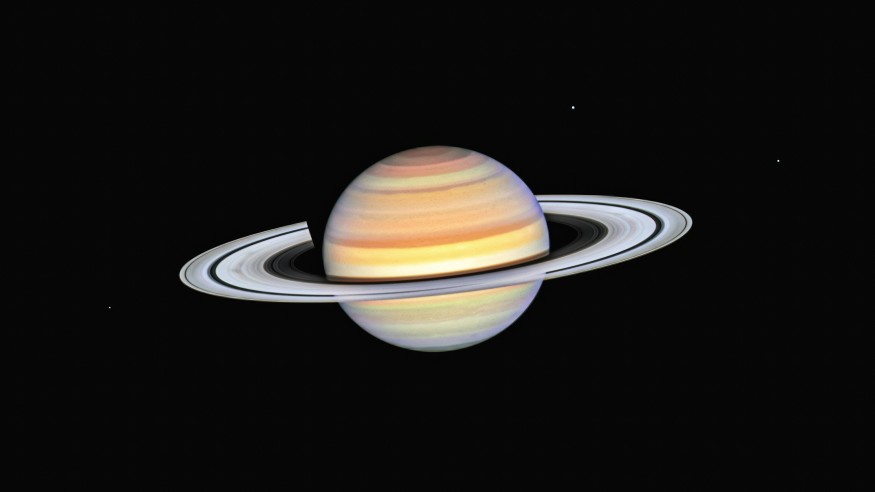
Saturn's rings have fascinated astronomers for centuries, with their icy brilliance hinting at a surprisingly young age. Recent studies suggest the rings formed far more recently than Saturn itself, possibly within the last 100–400 million years, rather than the solar system's 4.6 billion-year lifespan. Advanced modeling and Cassini data indicate that catastrophic moon collisions could have ejected icy debris into Saturn's Roche limit, forming the pristine disk we observe today.
Understanding Saturn rings origin sheds light not only on planetary ring formation but also on the history of its moons. The interplay of Titan, Hyperion, and a hypothesized lost moon called "Chrysalis" may have destabilized the inner system, triggering collisional cascades that funneled icy fragments toward Saturn. This emerging theory combines orbital dynamics, spectral analysis, and high-performance simulations to explain the rings' composition and relative youth.
Saturn Rings Origin Through Moon Collision Saturn
Saturn's ring origin may result from a massive collision between two proto-moons about the size of Dione and Rhea. This event likely occurred 100–200 million years ago and ejected roughly 10¹⁹ kg of material into unstable orbits. Tidal forces then shredded larger fragments into kilometer-scale icy particles forming the rings, while denser rocky cores coalesced into outer satellites such as Prometheus and Pandora.
Simulations show ice preferentially migrated inward past Saturn's Roche limit, creating a disk dominated by water ice. Cassini spectrometry confirmed the rings are over 99% pure ice, inconsistent with billions of years of meteoritic dust accumulation. This purity supports the theory that the rings formed from a recent disruptive event rather than primordial material.
Supercomputer models tested over 200 collision scenarios, showing that low-velocity, high-angle impacts best match the observed ring mass and composition. This explains the concentration of ice in the rings while allowing rocky remnants to form surviving moons.
Moon Collision Saturn and Titan-Hyperion Link
A mid-sized lost moon, "Chrysalis," may have merged with proto-Titan, expanding Titan's orbit and disrupting the 4:3 Titan-Hyperion resonance. This instability likely sent inner moons such as Mimas, Enceladus, and Tethys on collision courses, creating cascades of icy debris that contributed to the rings. Hyperion's chaotic rotation, low density, and rubble-pile structure fit as fragments from this merger.
Titan's smooth surface and thick nitrogen atmosphere also suggest resurfacing from impact heat, releasing volatiles that formed its dense haze. The interactions between Titan and its neighboring moons demonstrate how orbital dynamics can drive large-scale system-wide changes. This sequence of events provides a coherent framework linking moon collisions to the present-day Saturn ring system.
Evidence from Cassini and Orbital Dynamics
Cassini's moment-of-inertia measurements reveal Saturn's core is denser than expected, tilting its axis 26.7 degrees and likely influenced by Titan's orbital leap. Observations explain anomalies such as Iapetus's 15.5-degree inclination and Rhea's rapid outward migration crossing solar elevation resonances.
Simulations demonstrate how debris paths intersected inner moons, producing collisional cascades that formed Saturn's rings while reforming most fragments into current satellites. Grand Finale flybys confirmed ring-plane particles are micrometer-scale and extremely pure, setting an age under 400 million years. These lines of evidence support the moon collision Saturn hypothesis over primordial formation models.
Alternative Saturn Rings Origin Hypotheses
Primordial formation from Saturn's nebular disk struggles to explain the rings' purity and mass. Comet or Kuiper Belt object disruptions fail to account for ice abundance and dynamical stability. Mimas-scale moon tidal breakup inside the Roche limit matches mass but not the mid-sized moons' crater records.
Even the "Chrysalis grazing Saturn" scenario faces challenges, as debris infalling could overwhelm ring survival. While these models cannot fully account for all observations, they highlight the complexity of explaining Saturn rings origin. The moon collision hypothesis remains the most consistent with ice purity, ring mass, and orbital dynamics.
Dragonfly Mission Testing Moon Collision Saturn
NASA's 2028 Dragonfly mission to Titan will analyze surface geology, isotopic signatures, and organic compounds. Data may reveal traces of resurfacing from a past collision and help confirm whether Titan absorbed a lost moon like Chrysalis. Dragonfly's rotorcraft will also provide geophysical measurements that test orbital dynamics predictions linked to the rings.
This mission offers an unprecedented chance to validate models connecting moon collisions, debris dispersal, and ring formation. Observations may reveal Titan's history of impacts and resurfacing events that shaped the Saturn system we see today.
How Moon Collisions Shaped Saturn's Iconic Rings
Saturn's rings appear to be a relatively young and pristine feature of the planet, likely formed from icy debris produced during ancient moon collisions. Interactions between Titan, Hyperion, and a lost moon destabilized the inner system, generating cascades of material that became the rings. Cassini's observations and high-resolution simulations provide strong evidence linking these events to the rings' formation.
Understanding the origin of Saturn's rings offers insights into planetary system evolution and the dynamic processes that shape moons and debris disks. As missions like Dragonfly explore Titan, new data will refine models of moon collisions and ring formation, further explaining how Saturn became the striking ringed planet visible today.
Frequently Asked Questions
1. How old are Saturn's rings?
Saturn's rings are estimated to be 100–400 million years old, much younger than the planet itself. Their icy composition suggests a recent formation rather than primordial origin. Micrometer-scale purity supports this relatively young age. Moon collision models explain the timing of debris ejection.
2. What role did Titan play in the rings' formation?
Titan likely merged with a lost moon called Chrysalis, altering its orbit. This destabilized inner moons and triggered collisional cascades. Debris from these collisions contributed icy material to the rings. Titan's resurfacing also created its smooth surface and thick atmosphere.
3. Why are the rings made mostly of ice?
Collisions preferentially ejected icy mantles rather than rocky cores. Water ice dominates because it migrates inward past Saturn's Roche limit. Rocky material often formed surviving outer satellites. This explains the rings' observed 99% purity.
4. How will the Dragonfly mission help confirm this theory?
Dragonfly will study Titan's surface geology for impact and resurfacing evidence. It will analyze isotopic ratios in organics to trace material origins. Geophysical data may validate models of past orbital changes. This will provide direct insights into the moon collision hypothesis.
© 2026 ScienceTimes.com All rights reserved. Do not reproduce without permission. The window to the world of Science Times.


