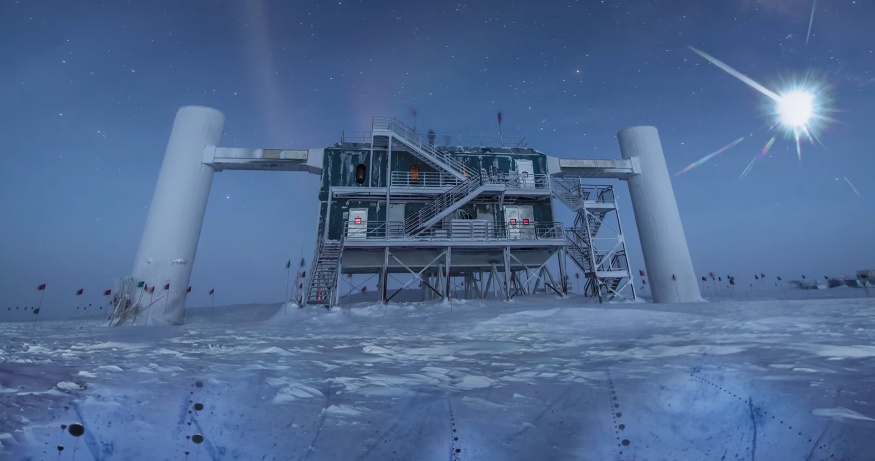
Neutrino physics is entering a transformative era as the IceCube upgrade deep beneath Antarctic ice enhances our ability to observe the universe's most elusive particles. Buried nearly a mile below the surface at the South Pole, this massive neutrino telescope detects faint signals from high-energy cosmic neutrinos that pass through planets, stars, and entire galaxies almost undisturbed. Unlike traditional observatories that rely on light, this branch of particle science captures subatomic messengers tied to cosmic rays and extreme astrophysical events.
Through advanced Antarctic research, scientists are mapping extragalactic neutrino sources linked to supermassive black holes, blazars, and powerful stellar explosions. The IceCube upgrade significantly boosts sensitivity and detection range, helping researchers connect neutrinos with gravitational waves and electromagnetic signals in coordinated multimessenger astronomy campaigns. These improvements are reshaping how we understand cosmic accelerators and the energetic processes that shape the universe.
What Does IceCube Detect in Antarctica?
The IceCube upgrade detects high-energy cosmic neutrinos produced when cosmic rays interact with matter or radiation near extreme astrophysical environments. In neutrino physics, these nearly massless particles are valuable because they travel in straight lines from their sources, carrying direct information about distant cosmic accelerators. When neutrinos collide with atoms in Antarctic ice, they generate secondary charged particles that emit Cherenkov radiation detection signals—brief flashes of blue light captured by digital optical modules.
This Antarctic research facility has linked neutrino events to distant blazars, including the well-known extragalactic source TXS 0506+056. By tracing these detections, particle science confirms that some active galactic nuclei produce both high-energy photons and neutrinos. The IceCube upgrade improves angular resolution and energy measurement, allowing scientists to pinpoint neutrino sources with greater precision and strengthen connections between cosmic rays and their astrophysical origins.
Cosmic Rays and the Origins of High-Energy Cosmic Neutrinos
Cosmic rays are charged particles that bend in magnetic fields, making their origins difficult to trace. Neutrino physics overcomes this challenge because neutrinos are electrically neutral and travel straight across cosmic distances without deflection. When cosmic rays collide with gas or radiation near powerful sources, they produce pions that decay into high-energy cosmic neutrinos. Using the IceCube upgrade, Antarctic research teams analyze neutrino direction, flavor, and energy to reconstruct the location and strength of the original cosmic accelerators.
High-energy cosmic neutrinos are believed to form in extreme environments such as active galactic nuclei, blazars, and starburst galaxies. In these regions, matter accelerates near supermassive black holes, generating jets that produce both cosmic rays and secondary neutrinos. The IceCube upgrade improves sensitivity to distant extragalactic neutrino sources beyond the Milky Way. By combining particle science data with gamma-ray observations, researchers refine models explaining how the universe's most energetic particles are created and distributed.
Neutrino Detection Technology Explained
The heart of neutrino physics at IceCube lies in Cherenkov radiation detection. When a neutrino interacts with the Antarctic ice, it produces a secondary particle—often a muon—that travels faster than light does in ice. This generates a faint blue glow known as Cherenkov radiation. Thousands of digital optical modules embedded deep in the ice capture these signals with precise timing.
Particle science algorithms then reconstruct three-dimensional particle tracks from the detected light patterns. This process determines the neutrino's direction and energy. The IceCube upgrade improves sensor sensitivity and calibration accuracy, expanding detection capabilities for both lower and ultra-high energies. As a neutrino telescope, IceCube transforms clear polar ice into a massive, naturally shielded observatory for cosmic ray investigations.
IceCube Upgrade, Multimessenger Astronomy, and High-Energy Cosmic Neutrino Sources
The IceCube upgrade expands detector density and monitored ice volume, improving neutrino physics measurements across a wider energy range. Enhanced optical modules and refined calibration systems increase sensitivity to high-energy cosmic neutrinos while reducing background interference from atmospheric muons. Faster timing and upgraded data systems also strengthen multimessenger astronomy by enabling rapid global alerts that connect neutrino events with gamma rays and gravitational waves.
These advancements help map high-energy source candidates linked to cosmic rays. Active galactic nuclei and tidal disruption events remain leading extragalactic neutrino sources, capable of accelerating particles near supermassive black holes. By analyzing direction and energy patterns, Antarctic research refines models of cosmic accelerators and deepens particle science insight into extreme cosmic environments.
Antarctic Research Challenges and the Future of Neutrino Physics
Antarctic research pushes the limits of engineering and particle science, requiring precision technology in one of the harshest environments on Earth. At the same time, the future of neutrino physics depends on overcoming these challenges to expand detection capabilities and explore deeper cosmic mysteries.
- Technical Challenges in Antarctic Research – Temperatures below -80°C require specialized electronics that can operate reliably in extreme cold. Ice movement must be monitored to maintain calibration accuracy over time. Particle science teams use advanced algorithms to filter out background noise from atmospheric cosmic rays. The IceCube upgrade improves calibration tools and signal rejection to protect data quality.
- Future Directions in Neutrino Physics – The IceCube Gen2 expansion aims to enlarge the detector array and boost sensitivity to ultra-high-energy cosmic neutrinos. Improved detection will refine localization of extragalactic neutrino sources. Beyond mapping cosmic rays, neutrino physics may probe mass hierarchy and possible sterile neutrino signatures. Continued Antarctic research keeps pushing the boundaries of particle science.
Explore Cosmic Accelerators Through IceCube Upgrade Discoveries
The IceCube upgrade represents a defining advance in neutrino physics, transforming Antarctic research into a global hub for particle science innovation. By tracing high-energy cosmic neutrinos back to their origins, scientists uncover how cosmic rays are accelerated in distant galaxies. Each detection strengthens the bridge between subatomic particles and large-scale cosmic structures.
As the IceCube Gen2 expansion progresses, the neutrino telescope will deepen our view of the universe's most energetic regions. Through multimessenger astronomy and refined Cherenkov radiation detection, particle science continues revealing hidden processes that shape galaxies, black holes, and the cosmic web itself.
Frequently Asked Questions
1. What is neutrino physics and why is it important?
Neutrino physics studies nearly massless particles that rarely interact with matter. These particles travel vast distances without being deflected, preserving information about their origins. This makes them valuable for studying cosmic rays and extreme astrophysical environments. Their detection expands our understanding of both particle science and the universe.
2. How does the IceCube upgrade improve detection?
The IceCube upgrade adds more sensitive optical modules and improved calibration systems. This increases detection accuracy and expands the observable energy range. It also enhances background rejection from atmospheric cosmic rays. These improvements allow better identification of extragalactic neutrino sources.
3. What are high-energy cosmic neutrinos?
High-energy cosmic neutrinos are particles produced in extreme cosmic accelerators. They often originate near black holes, blazars, or starburst galaxies. Their energy levels exceed those produced in most terrestrial experiments. Studying them reveals how cosmic rays are generated.
4. Why is Antarctic research ideal for neutrino detection?
The Antarctic ice provides a clear and stable medium for Cherenkov radiation detection. Its thickness shields detectors from much background radiation. The remote location reduces environmental interference. These conditions make it ideal for building a large-scale neutrino telescope.
© 2026 ScienceTimes.com All rights reserved. Do not reproduce without permission. The window to the world of Science Times.


