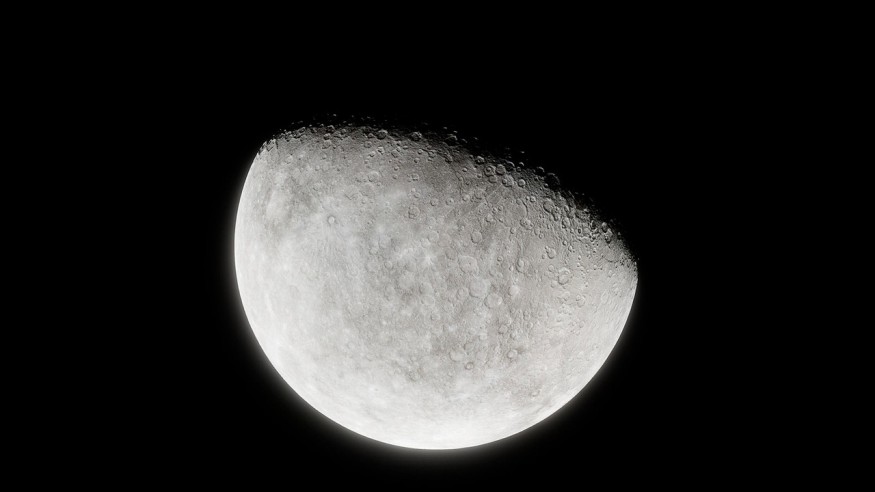
Mercury, the smallest planet in our solar system, may hide a diamond layer up to about 10 miles (16 kilometers) thick deep below its crust, according to new research based on NASA spacecraft data and high-pressure lab experiments.
An international team of scientists from China and Belgium used data from NASA's MESSENGER mission, along with lab "pressure cooker" experiments and computer models, to test how carbon behaves inside Mercury under extreme conditions.
Their work, published in the journal Nature Communications, suggests that a thick shell of diamond may sit near the boundary between Mercury's metallic core and rocky mantle. The layer is estimated to average around 9 to 10 miles thick, and in some models could reach up to about 11 miles (18 kilometers).
What was Found on Mercury's Surface?
MESSENGER images and measurements showed that Mercury's surface contains large patches of dark graphite, a form of carbon, hinting that the planet once had a carbon‑rich magma ocean, according to Daily Galaxy.
As this magma ocean cooled, lighter carbon floated up to form a graphite‑rich crust, while heavier, carbon‑bearing material sank toward the interior.
Under pressures above about 5.5 gigapascals and temperatures of roughly 3,600 degrees Fahrenheit, experiments indicate that carbon at the core–mantle boundary can transform from graphite into diamond.
Because diamond is less dense than molten metal, the crystals would tend to collect into a coherent layer at the top of the liquid outer core.
Mercury formed in a region of the early solar system that was richer in carbon, so it likely started out with more carbon than Earth, Venus, or Mars.
Scientists already knew its crust is unusually carbon‑rich compared with other rocky planets, but the new study argues that some of that carbon continued to move inward and reorganize into diamond over time.
Sulfur in Mercury's interior appears to lower the melting point of its magma and further support the formation and stability of diamond at depth, the India Times reported.
Mercury is surprisingly small yet still has an active global magnetic field, unlike most similar‑sized bodies. The researchers propose that a highly conductive diamond shell could help move heat efficiently from the core to the mantle, driving the motion of liquid iron that powers this magnetic field.
The diamonds, however, are thought to sit hundreds of miles below the surface, far beyond the reach of any mining technology and exposed to extreme temperatures.
Upcoming missions such as ESA–JAXA's BepiColombo, now on its way to Mercury, may provide new data to test these models and refine estimates of the hidden diamond layer, as per Live Science.
© 2026 ScienceTimes.com All rights reserved. Do not reproduce without permission. The window to the world of Science Times.


