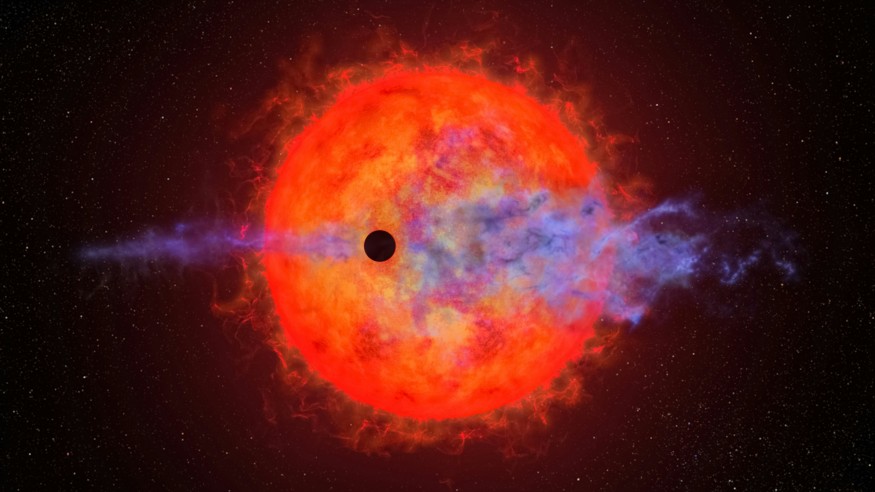
The idea that mini universes could form inside dying stars is gaining attention in space science research and new physics discussions. Instead of ending as black holes, collapsing stars may become ultra-compact objects influenced by dark energy, with gravastars proposed as an alternative where outward pressure prevents a singularity.
This view changes how stellar collapse is understood. Rather than forming an infinitely dense point, it may trigger conditions similar to a Big Bang inside the core, creating an expanding region that behaves like a mini universe and challenges standard space science models.
What Happens When A Star Collapses
Massive stars spend their lives balancing gravity with radiation pressure created by nuclear fusion. Once that fuel runs out, that balance collapses and gravity takes over completely.
For very large stars, this collapse happens extremely quickly and can trigger a powerful supernova explosion. What remains is a core compressed into an extremely dense state.
In the standard black hole model, this core becomes a singularity where matter is squeezed into a single point. However, this raises questions in theoretical physics because known laws begin to break down.
Black holes cannot be directly observed since not even light escapes them, making their interiors one of the biggest mysteries in space science research.
How Mini-Universes Could Form
The mini universes idea is linked to gravastars, where collapsing stars do not form singularities but instead develop a dark energy-filled core. This dark energy creates outward pressure that balances gravitational collapse.
In this scenario, the collapsing star may generate conditions similar to a Big Bang inside its interior. That expanding region could evolve into a self-contained mini universe while the outer structure continues collapsing.
Rather than replacing black holes entirely, this model suggests an alternative outcome at extreme conditions. It presents a balance between collapse and expansion, offering a new perspective in new physics research.
Why Scientists Are Considering New Physics
Scientists are exploring new physics because black holes still leave major gaps in understanding, especially at the singularity where equations fail. Since direct observation is impossible, collapsing stars remain open to interpretation.
The gravastar model is not meant to reject black holes but to test how extreme conditions might behave under different assumptions. Researchers argue that exploring alternative ideas is essential in theoretical physics.
The mini universes concept is especially intriguing because it shifts collapse from a purely destructive process into one that may also involve expansion. This changes how space science research views the final stages of massive stars.
Mini-Universes Could Redefine What Dying Stars Become
The possibility that mini universes could form inside dying stars offers a new direction for space science research by linking stellar collapse with cosmic creation. Instead of ending in a singularity, collapsing stars may form gravastars shaped by dark energy and governed by new physics.
This idea suggests that the universe may be far more interconnected at extreme scales than previously thought, opening new questions about how matter, gravity, and expansion interact in the deepest regions of space.
© 2026 ScienceTimes.com All rights reserved. Do not reproduce without permission. The window to the world of Science Times.


