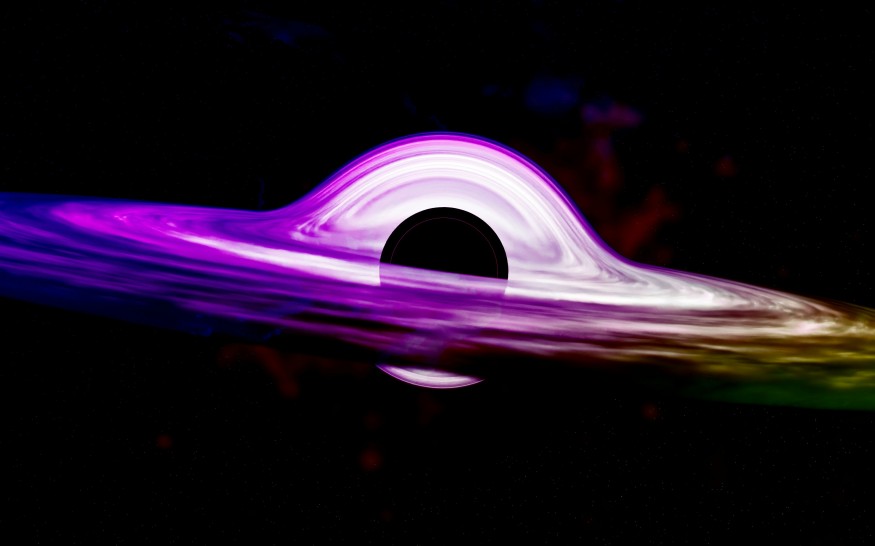
Do black holes end is one of the most intriguing questions in modern physics, tied closely to quantum mechanics and general relativity. Black hole evaporation occurs through Hawking radiation, where quantum fluctuations near the event horizon generate particle pairs, causing the black hole to slowly lose mass over extremely long timescales. Depending on size, this process can take from 10^10 seconds for tiny primordial black holes to around 10^67 years for solar-mass ones.
The fate of black holes also connects to the broader black hole lifecycle, which begins with stellar collapse and may evolve into supermassive structures at galactic centers. As these objects age, black hole evaporation becomes dominant in isolated conditions where no new matter is accreted. This raises deeper questions about what happens at the final stage of a black hole's existence and whether complete disappearance is truly possible.
How Black Hole Evaporation Works Through Hawking Radiation
Do black holes end through Hawking radiation is explained by quantum field effects near the event horizon. Virtual particle pairs constantly form in empty space, and when one particle falls into the black hole while the other escapes, the black hole loses energy. This process produces a faint thermal spectrum known as Hawking radiation, gradually reducing the black hole's mass.
Black hole evaporation is governed by temperature inversely related to mass, meaning smaller black holes emit radiation faster. Over time, this accelerates the loss process as the black hole shrinks, eventually leading to a final burst of high-energy radiation. The fate of black holes in this phase depends on whether they exist in isolation, since accretion from surrounding matter can temporarily counteract evaporation.
Black Hole Lifecycle Stages and Final Fate Possibilities
Black hole lifecycle describes how these extreme objects are born, evolve, and potentially end over cosmic timescales. Do black holes end as a meaningful question only when they stop gaining mass from surrounding matter and enter a slow evaporation phase. Their evolution depends on mass, environment, and long-term quantum effects.
- Stellar Formation Stage – Black holes begin when massive stars collapse after supernova explosions, leaving behind dense gravitational remnants.
- Growth and Merging Stage – These black holes can merge or accumulate matter over time, eventually forming supermassive black holes at galactic centers.
- Galactic Influence Stage – In this phase, they shape galaxy dynamics through intense gravitational forces and energy interactions.
- Isolation Trigger Point – The question of do black holes end becomes relevant once accretion stops and external matter no longer feeds the system.
- Evaporation Dominance Stage – Black hole evaporation takes over, where Hawking radiation slowly reduces mass over extremely long timescales.
- Final Fate Possibilities – Fate of black holes at the end may involve complete disappearance or Planck-scale remnants depending on unresolved quantum gravity effects.
Read more: Exploring Singularity Physics from Black Holes and Accretion Disks to the Event Horizon Telescope
Fate of Black Holes and Information Paradox Resolution Theories
The fate of black holes is deeply connected to the information paradox, which questions whether information that falls into a black hole is lost forever. Quantum theory suggests information should be preserved, while classical descriptions of black hole evaporation imply it disappears, creating a major conflict in physics. This has led to multiple theoretical solutions involving advanced quantum gravity concepts.
Do black holes end in a way that preserves information is explored through ideas like the Page curve and quantum entanglement islands. These models suggest that information may gradually reappear in Hawking radiation over time. Black hole lifecycle theories such as fuzzballs and soft hair propose alternative structures that avoid true information loss altogether.
Understanding Black Hole Evaporation Final Stages Timeline
Do black holes end through Hawking radiation over unimaginable timescales, slowly transitioning from stellar remnants to fading quantum objects. Black hole evaporation ultimately defines the final phase of the black hole lifecycle, where mass loss dominates and spacetime effects become increasingly significant. The fate of black holes remains one of the deepest unresolved topics in theoretical physics.
As evaporation progresses, black holes may shrink to Planck-scale remnants or vanish completely depending on the correct quantum gravity model. These final stages could reveal new physics about spacetime, entropy, and the fundamental structure of reality. The study of black hole evaporation continues to shape our understanding of the universe's ultimate fate.
Frequently Asked Questions
1. Do black holes really end completely?
Black holes are predicted to end through Hawking radiation over extremely long timescales. However, the exact final outcome is still uncertain. Some theories suggest complete evaporation, while others propose stable remnants. The answer depends on future quantum gravity discoveries.
2. What is black hole evaporation?
Black hole evaporation is the gradual loss of mass caused by Hawking radiation. Particle pairs near the event horizon result in energy escaping the black hole. Over time, this reduces its size and temperature. Eventually, it may lead to full disappearance or a final remnant.
3. How long is the black hole lifecycle?
The black hole lifecycle varies depending on its mass. Stellar black holes can last around 10^67 years before fully evaporating. Supermassive black holes may persist even longer. Their final stage depends on environmental conditions and isolation.
4. Can information escape a black hole?
This is still debated due to the black hole information paradox. Some theories suggest information is encoded in Hawking radiation. Others propose quantum structures that preserve it inside spacetime geometry. No final experimental proof exists yet.
© 2026 ScienceTimes.com All rights reserved. Do not reproduce without permission. The window to the world of Science Times.


