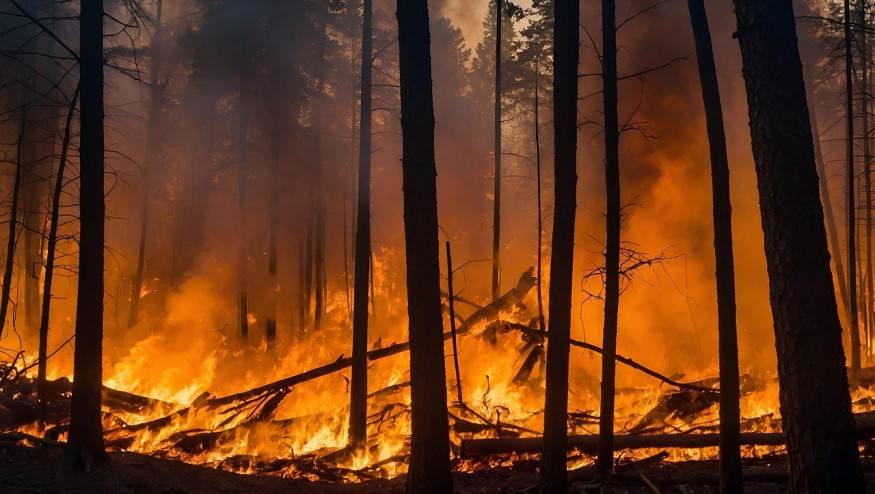
Fire can do more than burn, it can reshape the air above it. In extreme cases, wildfires generate spinning columns of heat and flame known as fire whirls and fire tornadoes weather events, where vortices form directly from the intense energy of the blaze.
These rare but dangerous phenomena highlight how fire can create its own localized weather systems, complicating firefighting efforts and increasing risks to communities.
What Are Fire Whirls and Fire Tornadoes?
Fire whirls are rapidly rotating columns of air and flame that form when rising heat meets turbulent wind conditions. They are typically smaller, short-lived, and can appear as twisting flames or spinning plumes of ash.
Fire tornadoes, on the other hand, are larger, more powerful, and longer-lasting. These intense vortices can reach heights of hundreds of meters, with wind speeds strong enough to uproot trees and destroy structures.
The main difference lies in scale and intensity. While both involve rotating air driven by heat, fire tornadoes weather events behave more like traditional tornadoes in strength and impact. Both, however, are rooted in the same principle: rising hot air interacting with unstable atmospheric conditions.
How Wildfires Create Their Own Weather Systems
Large wildfires release enormous amounts of heat and energy, which can significantly alter local atmospheric conditions. This process is often referred to as fire-induced weather.
As hot air rises from the flames, it creates strong updrafts that pull in surrounding air. This movement can lead to instability in the atmosphere, forming clouds known as pyrocumulus or, in more extreme cases, pyrocumulonimbus.
These cloud systems can produce lightning, strong winds, and even precipitation, all generated by the fire itself. In this environment, vortices such as fire whirls can form more easily due to the chaotic mixing of air currents.
The Science Behind Fire Vortices
At the core of fire whirls and fire tornadoes weather events is the physics of rotating air, or vortices. These form when rising hot air creates a low-pressure zone near the ground. Surrounding air rushes in to fill this gap, and under the right conditions, begins to spin.
Temperature differences play a key role. The hotter the fire, the stronger the updraft. When combined with wind shear, differences in wind speed or direction at different heights, this can create organized rotation.
As the vortex tightens, it can intensify, much like a figure skater pulling in their arms to spin faster. In extreme cases, a small fire whirl can grow into a powerful fire tornado.
Real-World Examples of Fire Whirls and Fire Tornadoes
History offers several striking examples of these phenomena. One of the most infamous occurred during the 1923 Great Kanto Earthquake in Japan, where a massive fire whirl reportedly killed tens of thousands of people in a single event.
More recently, the 2018 Carr Fire in California produced a fire tornado with wind speeds equivalent to an EF3 tornado. It uprooted trees, destroyed homes, and demonstrated the destructive potential of fire tornadoes and weather events.
Australia has also recorded numerous fire whirls during bushfire seasons, often captured on video as towering spirals of flame moving unpredictably across the landscape.
Dangers and Impact on Firefighting Efforts
The unpredictable nature of fire whirls and fire tornadoes weather events makes them especially dangerous. These spinning columns can change direction rapidly, spread embers over long distances, and ignite new fires far from the original blaze.
For firefighters, these vortices create hazardous and rapidly shifting conditions. Standard containment strategies can become ineffective when winds generated by the fire itself alter fire behavior.
Additionally, fire tornadoes can intensify flames and increase the rate at which wildfires spread, making evacuation efforts more urgent and complex.
Climate Change and the Rise of Extreme Fire Behavior
Climate change is contributing to more frequent and severe wildfires, which in turn increases the likelihood of fire whirls and fire tornadoes weather events. Rising temperatures, prolonged droughts, and changing weather patterns create ideal conditions for large fires.
As fire seasons lengthen and fuels become drier, the intensity of fire events grows. This increases the chances of generating the strong updrafts and atmospheric instability needed for vortices to develop.
Researchers are increasingly concerned that these extreme fire behaviors could become more common in the future.
Can Fire Whirls Be Predicted or Prevented?
Predicting fire whirls and fire tornadoes weather events remains a challenge. While meteorologists and fire scientists can identify conditions that favor their formation, pinpointing exactly when and where they will occur is difficult.
Advanced tools such as satellite monitoring, weather modeling, and AI-driven fire prediction systems are improving forecasting capabilities. These technologies help track wildfires and detect signs of extreme behavior.
Prevention focuses on reducing fuel loads, managing forests, and implementing controlled burns. While these measures cannot eliminate vortices, they can lower the intensity of fire events and reduce the risk.
Why Fire Whirls and Fire Tornadoes Weather Events Matter More Than Ever
As wildfires grow in scale and intensity, understanding phenomena like fire whirls, fire tornadoes, weather events, and the vortices that drive them becomes increasingly important. These events are not just scientific curiosities, they are indicators of how powerful and unpredictable fire can become under the right conditions.
Greater awareness, improved forecasting, and better land management strategies will play a critical role in reducing risks. As research continues, scientists aim to better understand how fire, atmosphere, and terrain interact to produce these dramatic and dangerous events.
Frequently Asked Questions
1. What is the difference between a fire whirl and a dust devil?
A fire whirl contains flames and is driven by heat from a fire, while a dust devil forms from ground heating and carries dust or debris without combustion.
2. Can fire whirls occur in urban fires?
Yes, large urban fires with intense heat and confined spaces can generate fire whirls, especially where airflow is restricted and channeled.
3. Do fire tornadoes show up on weather radar?
Some strong fire tornadoes associated with pyrocumulonimbus clouds can appear on radar, but smaller ones are often too localized to detect.
4. How long do fire whirls usually last?
Most fire whirls last only a few minutes, although stronger ones can persist longer if conditions remain favorable.
© 2026 ScienceTimes.com All rights reserved. Do not reproduce without permission. The window to the world of Science Times.


